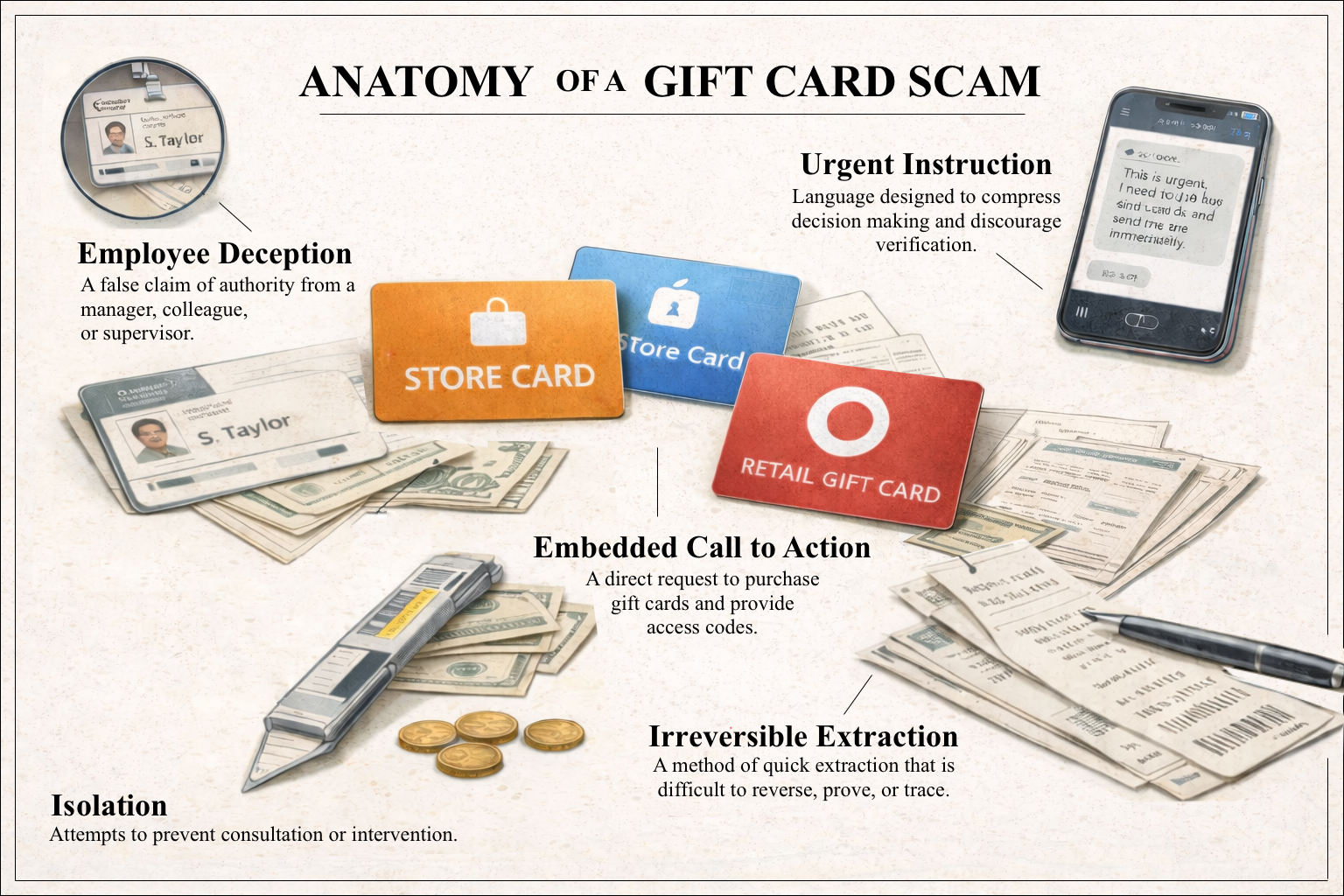
Anatomy of a Gift Card Scam
How authority, urgency, and routine combine to produce irreversible transfer.
A gift card scam rarely begins with a gift card.
It begins with authority.
The initial message is usually framed as routine and responsible. A manager, colleague, client, or institutional voice appears to make a request that feels plausible within the context of work or obligation. The request does not initially mention loss. It presents a task.
This is the first component: borrowed authority.
The authority does not need to be real. It only needs to resemble something already trusted. The message often arrives through a familiar channel — email, text, or messaging platform — and its tone is calibrated to feel efficient rather than suspicious.
Once authority is established, timing is introduced.
The request is positioned as urgent but reasonable. A deadline appears that discourages verification without feeling theatrical. The pressure is framed not as panic, but as responsibility.
This is the second component: urgency that feels procedural.
The recipient is not asked to act recklessly. They are asked to act promptly.
The next step reframes the task.
The purchase of gift cards is presented as a practical solution to a legitimate problem — fulfilling a request, completing a transaction, assisting a colleague. The act of purchasing becomes a form of compliance rather than a transfer.
This is the third component: conversion of action.
A retail activity is quietly transformed into a financial one.
Isolation often follows.
Additional instructions discourage consultation or verification. The request may specify discretion, speed, or a desire to avoid involving others. This framing positions independent action as professionalism.
This is the fourth component: containment of attention.
The recipient is encouraged to act without introducing external perspectives that might slow the process.
Finally, extraction occurs.
Gift cards function as instruments that bypass the safeguards normally attached to money. Once acquired and transmitted, their value can be moved without traceability or reversal.
This is the fifth component: irreversibility.
The scam does not rely on deception alone. It relies on the familiarity of each step.
Authority feels routine.
Urgency feels responsible.
Purchase feels practical.
Isolation feels efficient.
By the time extraction occurs, the sequence has already been normalized.
Gift card scams persist not because they are elaborate, but because they are assembled from actions that people perform every day.
Understanding the structure does not eliminate the possibility of loss.
It clarifies how legitimacy, timing, and routine combine to produce it.